75 Hard Mindset vs 75Mind: Why a Mindset-First 75-Day Challenge Works Differently
You finish 75 Hard with a streak and a question: why did the old patterns return? The tasks built discipline, but they never touched the beliefs quietly steering your choices. That gap matters more than the checkmarks.
By the end, you will understand how Eli Bowman's 75Mind reframes the challenge around unconscious pattern work, how it differs from the 75 Hard mindset, and who each approach actually suits. You will also know what 75Mind includes, its pricing, and whether it fits your goals.
What Is Eli Bowman and How Does 75Mind Fit Into His Work?
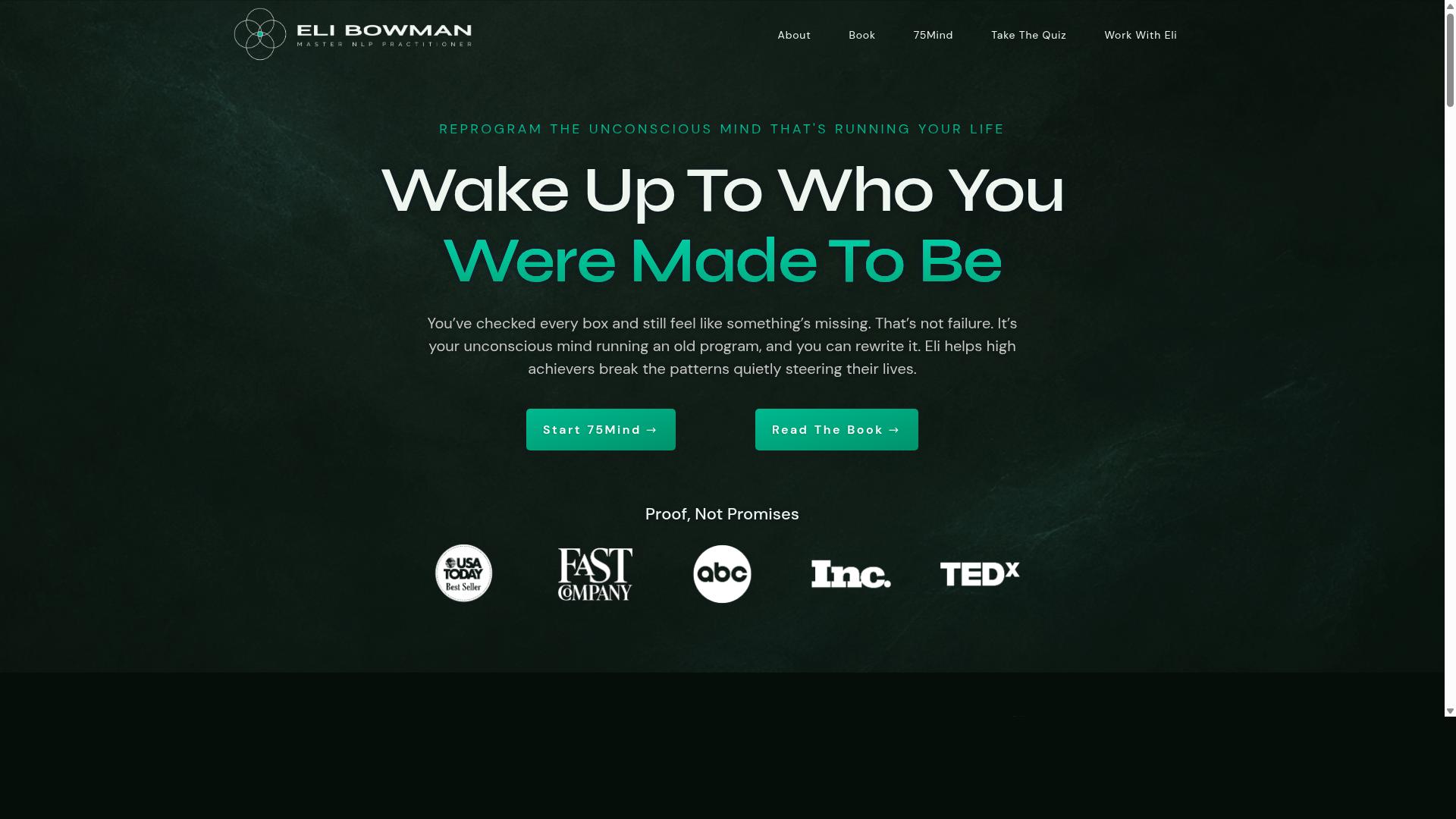
Eli Bowman is a mindset speaker, author, and NLP coach who helps high achievers identify and reprogram unconscious patterns that hold them back. His work sits at the intersection of personal development and behavior change, with a focus on the mental wiring that quietly shapes decisions, habits, and results.
75Mind is his signature 75-day mindset program and the clearest expression of that philosophy. Where many challenges treat discipline as the goal, Bowman treats it as the doorway to something deeper: lasting internal change.
The program weaves together two threads that define his broader body of work. The first is NLP, the set of techniques he uses to surface and reframe unconscious patterns. The second is the daily practice of habits that keep that inner work visible and measurable.
That combination is what sets the stage for everything that follows. To understand why a mindset-first challenge behaves differently from a rule-based one, it helps to first understand the person behind it and the program itself.
Who Eli Bowman Is: Mindset Speaker, Author, and NLP Coach
Eli Bowman is a TEDx speaker, USA Today bestselling author, and Master NLP Practitioner certified by the American Board of Neuro-Linguistic Programming. Those credentials anchor a career built on one central idea: the unconscious mind steers more of life than most high achievers realize.
His path to that idea was not a straight line. Bowman shares that he spent nearly 20 years building companies, some of which failed before successful ones followed. Learning how the unconscious mind works changed his approach, and that shift became the foundation of his coaching.
Today his work reaches people through several channels:
- One-on-one coaching for personalized insight into unconscious patterns
- Keynote speaking for events and organizations
- Retreats and live experiences for deeper, in-person work
- His book, "The Program", a USA Today bestseller on reprogramming the unconscious mind
- 75Mind, his 75-day mindset program
The business behind this work is operated by Movement Maker LLC. Bowman is the founder and primary figure, and his audience tends to be high performers who have already achieved external success but sense that something internal is still running the show.
That audience matters for understanding his approach. He is not teaching people how to want more. He is teaching them how to stop unconscious patterns from quietly working against goals they already care about.
What 75Mind Is - and How It Differs From 75 Hard's Mindset
75Mind is a mindset-first 75-day challenge that focuses on reprogramming unconscious patterns, unlike 75 Hard's rule-based approach. It is delivered as a digital product and built around eight daily habits that pair inner work with tangible action.
The daily habits are specific and repeatable:
- Track sleep
- Morning gratitude practice
- Meditation or prayer
- 30 minutes of intentional physical movement
- At least 30 minutes of focused reading
- Daily social accountability
- Drink 100 oz of water
- Evening journal entry
The program also includes a participant guide PDF, a phase-by-phase roadmap, daily reflection prompts, clear rules, standards, and expectations, and community access. It unfolds across four phases: Disruption (Days 1-18), Confrontation (Days 19-37), Rebuild (Days 38-60), and Momentum (Days 61-75).
This is where the contrast with 75 Hard becomes clear. 75 Hard leans on external tasks and rigid rules, which builds discipline through compliance. 75Mind targets internal change, using structure as scaffolding for cognitive reframing rather than as the finish line itself.
That distinction shapes how each approach motivates people. A rule-based system draws heavily on willpower and the fear of breaking a streak. A flexible framework built around reflection and awareness cultivates intrinsic motivation, the kind that survives after day 75 ends.
For readers weighing the two, the practical question is simple. If you want proof you can follow orders, a rule-based challenge delivers that. If you want to understand why you sabotage yourself in the first place, a mindset-first challenge is built for exactly that work.
Why a Mindset-First 75-Day Challenge Works Differently
A mindset-first 75-day challenge works differently because it addresses the root causes of behavior rather than just the symptoms. Traditional fitness challenges treat the body as the project. A mindset-first approach treats the operating system underneath the behavior as the project.
That distinction matters for anyone who has finished a hard challenge and then watched old patterns return within weeks. External results built on willpower alone tend to fade once the structure disappears. Internal change, by contrast, travels with you.
Eli Bowman, a USA Today bestselling author, TEDx speaker, and Master NLP Practitioner certified by the American Board of Neuro-Linguistic Programming, built 75Mind around this idea. It is mindset-first, not fitness-first, and grounded in NLP principles rather than pure physical endurance.
This reframing sets up two ideas explored below. First, the unconscious mind drives far more of daily behavior than most people realize. Second, discipline built through repetition alone differs fundamentally from reprogramming from within.
The 90-95% Unconscious Mind Principle Behind 75Mind
The 90-95% unconscious mind principle suggests that most of our daily actions are driven by unconscious patterns, not conscious willpower. Bowman emphasizes a neuroscience-based approach, stating that 90-95% of everything you do, feel, and decide is controlled by the unconscious mind.
If that figure is even close to accurate, then most self-improvement advice is aimed at the wrong target. Pushing harder on conscious effort fights a battle that the unconscious mind usually wins. 75Mind takes the opposite route: identify the pattern, then reprogram it.
Common unconscious patterns that hold people back include:
- Self-sabotage, where a person creates obstacles right before a breakthrough
- Limiting beliefs, such as "I never finish what I start"
- Automatic avoidance, where discomfort triggers instant distraction
- Identity statements repeated so often they feel like facts
NLP offers tools for surfacing and shifting these patterns. Bowman's certification as a Master NLP Practitioner means the 75Mind framework applies those techniques directly, rather than treating mindset as motivational decoration.
The program still demands real structure. Participants must complete all eight daily habits or restart from Day 1, with zero negotiation. The difference is what those habits are designed to do: not just build a streak, but rewrite the patterns underneath it.
Discipline Through Repetition vs. Reprogramming From Within
Discipline through repetition relies on external tasks and willpower, while reprogramming from within focuses on changing unconscious patterns for lasting change. Both approaches produce early results. They diverge when life gets difficult.
Repetition-based systems, like 75 Hard, build mental toughness through a fixed task list. That structure works for many people, and the grit it develops is real. The risk is that willpower is a limited resource, and a system that depends on it can collapse the moment motivation dips.
When that happens, people often experience burnout or relapse. The tasks stop, and because nothing internal changed, the old defaults return. A fitness challenge can end with a fitter body and the same unhelpful mental patterns.
Reprogramming works differently. NLP and cognitive reframing target the beliefs and automatic reactions that produce behavior in the first place. Examples include:
- Reframing "I failed today" into "I learned what triggers me"
- Replacing an identity like "I'm lazy" with a specific, evidence-based self-description
- Interrupting an automatic stress response before it drives a decision
This is where 75Mind separates itself from a standard fitness challenge. The eight daily habits must be completed with zero negotiation, so accountability and consistency remain strict. But the purpose of those habits is internal rewiring, not just task completion.
The result is a transformation program built for durability. Streaks end. A reprogrammed mindset does not.
75 Hard Mindset vs 75Mind: The Core Differences
The core differences between 75 Hard and 75Mind lie in their fundamental approaches: one focuses on external rules, the other on internal reprogramming. Both span 75 days, but they aim at very different targets.
75 Hard is a fitness challenge built on a fixed checklist of daily tasks. Complete every task, every day, or the streak resets to day one. Its power comes from structure, and its lessons center on discipline and mental toughness.
75Mind is a mindset program. Instead of asking what you should do each day, it asks why you keep repeating the patterns that hold you back. The work happens beneath behavior, not on top of it.
That distinction shapes everything: how progress is measured, what counts as a setback, and who gets the most from each path. The sections below break down the two models side by side.
Rules and Tasks vs. Unconscious Pattern Work
75 Hard requires completing five daily tasks, while 75Mind involves identifying and reprogramming unconscious patterns that drive behavior. The two approaches could hardly be more different in method.
The 75 Hard rules are strict and measurable. Each day calls for two workouts, one of them outdoors, a gallon of water, a diet followed without cheat meals, ten pages of reading, and no alcohol. Miss any item and the challenge restarts. It is a rule-based system through and through.
That design builds willpower, grit, and self-control. For many people, it is the first time they have kept a promise to themselves for weeks on end. The tasks are visible, countable, and easy to track.
75Mind works in the opposite direction. Rather than adding tasks, it examines the unconscious patterns that quietly shape decisions: the procrastination before important work, the self-sabotage right before a breakthrough, the restlessness that success never seems to cure.
It draws on tools such as journaling, meditation, and NLP-style reframing to surface those patterns and change them at the root. Progress is not a checkbox. It shows up as a shift in how you respond to pressure, opportunity, and your own inner resistance.
The key contrast is orientation. 75 Hard is task-oriented: do the things. 75Mind is transformation-oriented: become the person for whom the old patterns no longer fit. One builds a stronger version of who you already are. The other questions who that person has been all along.
Who Each Approach Suits - and Where 75Mind Goes Further
75 Hard suits those who thrive on structure and external accountability, while 75Mind is designed for high achievers who feel stuck despite external success. Each format rewards a different kind of person.
If you respond well to clear rules, deadlines, and visible streaks, 75 Hard can be a powerful entry point. Extrinsic motivation carries you through the early weeks, and the daily checklist removes the need to decide anything. Fitness enthusiasts and anyone rebuilding consistency often flourish here.
75Mind speaks to a different profile. Its audience includes high achievers who feel something is missing despite checking every box, people struggling with self-sabotage, career or income ceilings, vague restlessness, and those seeking clarity on purpose. Organizations looking for speakers, retreats, or ways to bring this work to their teams also fit the model.
Here is where 75Mind goes further. A rule-based system can change what you do for 75 days, but it may never touch the unconscious barrier that caused the ceiling in the first place. You can finish every task and still sabotage the promotion, the relationship, or the next big opportunity.
By targeting cognitive reframing, emotional regulation, and psychological flexibility, 75Mind addresses the layer beneath behavior. That is the layer where lasting behavior change actually begins.
- 75 Hard: best for structure-seekers, fitness-focused individuals, and anyone who needs external accountability to build discipline.
- 75Mind: best for high achievers, self-sabotage patterns, career or income ceilings, restlessness, and the search for purpose.
- The difference: one strengthens the habits you already understand; the other rewires the patterns you have never questioned.
Neither path is wasted. But if you have already proven you can keep promises to yourself and still feel stuck, the missing piece is rarely another checklist. It is the internal reprogramming that a mindset-first challenge like 75Mind was built to deliver.
What Makes 75Mind Stand Out
75Mind stands out because it combines neuroscience-based NLP techniques with a structured 75-day framework to create deep, lasting change. Where most challenges ask you to grind through tasks by sheer force of will, this one asks you to understand why your brain resists change in the first place. That shift in starting point changes everything that follows.
Eli Bowman is a USA Today bestselling author, TEDx speaker, and Master NLP Practitioner certified by the American Board of Neuro-Linguistic Programming. That certification is not a marketing label. It reflects formal training in how language, thought patterns, and behavior interconnect, and it shapes how the entire program is built.
His core premise is striking in its simplicity: 90-95% of everything you do, feel, and decide is controlled by the unconscious mind. If that number is even close to accurate, then most self-improvement efforts are aimed at the wrong target. Willpower lives in the conscious mind, and the conscious mind is the minority shareholder.
This is where the program separates itself from a purely fitness-driven challenge. 75Mind is mindset-first, not fitness-first, and it is built on NLP principles rather than workout quotas. The daily habits may include physical activity, but the engine driving the whole thing is unconscious reprogramming.
The structure itself is deliberately strict. Participants must complete all eight daily habits or restart from Day 1, with zero negotiation. That rule matters more than it first appears. It removes the mental bargaining that quietly erodes most personal development efforts, the internal debate about whether today counts or whether an exception is reasonable.
For high achievers, this combination tends to land differently than a standard transformation program. High performers rarely lack ambition or work ethic. What they often lack is a system that reaches the unconscious patterns running beneath their conscious intentions. A neuroscience-based approach targets that layer directly.
Consider what a typical day looks like in practice:
- Eight required daily habits, all of which must be completed
- No partial credit and no renegotiation of the terms
- A restart from Day 1 if any habit is missed
- Mindset work grounded in NLP techniques rather than fitness metrics alone
The restart rule is not punishment for its own sake. It functions as a rule-based system that trains consistency and self-control under real conditions, not ideal ones. Over 75 days, that repetition is what begins to shift automatic behavior.
This is also why the program suits people who have already tried discipline-driven approaches and found them insufficient. Grit and resilience matter, but they are finite resources when used as the only tool. Pairing them with cognitive reframing and unconscious reprogramming gives those qualities somewhere durable to anchor.
In short, 75Mind is a mindset-first challenge for people who want transformation that outlasts the challenge itself. The 75-day container provides accountability and structure. The NLP foundation provides the mechanism for genuine behavior change. Together, they aim at something deeper than a streak, and that is what makes the program distinct.
Pricing and Access
75Mind is priced at $75 as a one-time purchase with instant access, making it an affordable entry point for mindset transformation. There is no subscription, no recurring billing, and no tiered upsell waiting on the other side of checkout. You pay once, and the program is yours.
That single price matters more than it might first appear. Most transformation programs in the personal development space rely on monthly memberships or tiered packages, which means your commitment to the work gets tangled up with an ongoing financial commitment. 75Mind separates the two. The only thing you have to sustain for 75 days is your own effort.
Access is immediate and global. Because 75Mind is delivered online, participants can begin from anywhere in the world, in any time zone, without waiting for a cohort start date or a shipping window. If you decide today is day one, it can be.
Beyond the $75 program, Eli Bowman also works with clients through coaching and speaking engagements. Those are quoted on a custom basis, since scope, format, and audience vary from one engagement to the next. Anyone interested in those services should reach out directly for a quote rather than expect a published rate card.
For readers weighing 75Mind against a rule-based system like 75 Hard, the cost comparison is worth noting. 75 Hard itself is free, but it often comes with hidden expenses: gym memberships, specific books, meal prep, and the cost of restarting after a missed day. 75Mind's one-time fee covers the framework itself, and nothing about it requires a restart penalty.
It is also worth being clear about what the $75 does not include. There is no publicly listed premium tier, no add-on library, and no separate charge for the core program. The price you see is the price you pay, which keeps the decision simple and the focus where it belongs: on the daily work of building mental toughness and consistency.
Trust Signals: Eli Bowman's Credentials and Track Record
Eli Bowman's credentials include being a TEDx speaker, USA Today bestselling author, and Master NLP Practitioner certified by the American Board of Neuro-Linguistic Programming. Those three markers matter for a mindset-first challenge because they speak to both public credibility and formal training in how the mind actually works.
A TEDx talk requires a speaker to organize a complex idea into something a general audience can follow and apply. A USA Today bestselling book requires the same discipline at greater length. Together, they suggest Eli Bowman can communicate ideas clearly rather than hide behind jargon.
The NLP certification is the piece most directly tied to the 75Mind approach. Certification through the American Board of Neuro-Linguistic Programming indicates structured training in cognitive reframing, behavioral patterns, and unconscious mind work. That is the same territory a mindset-first challenge operates in.
Eli Bowman also shares that he spent nearly 20 years building companies, and that some failed before the successful ones. That detail matters. A track record that includes failure alongside success is often more useful to someone attempting a 75-day challenge than a story with no setbacks in it.
He has said that learning how the unconscious mind works changed his approach. That single statement connects his business history to the philosophy behind 75Mind: lasting behavior change starts internally, not with an external rule set.
For readers weighing 75 Hard against 75Mind, credentials alone should not decide the question. But they do answer a fair concern. When a program asks you to trust a framework for 75 days, it helps to know the person behind it has formal training, public speaking experience, and real business scars to draw from.
One honest note on trust signals: testimonials shown on the 75Mind page are placeholder text, not verified client stories. Readers should weigh the credential facts above rather than treat that placeholder copy as proof of results. Recognizing that distinction is itself part of the critical thinking a mindset-first challenge aims to build.
The verdict here is straightforward. Eli Bowman's combination of speaking, authorship, NLP certification, and two decades of business experience makes him a credible guide for a mindset-first 75-day challenge. His background supports the core claim of 75Mind: that mental toughness and discipline are trainable, and that the internal work is what makes consistency stick.
Who 75Mind Is For
75Mind is for high achievers who feel something is missing despite checking every box, and for those struggling with self-sabotage or a career ceiling. These are people who look successful on paper yet sense a gap between where they are and where they know they could be.
The program speaks to a specific kind of person. Not someone who needs to be convinced to work harder, but someone who has already done the work and still feels stuck. The problem is not effort. The problem is what is driving the effort.
Eli Bowman built 75Mind for people who recognize themselves in at least one of these patterns:
- High achievers who feel something is missing despite checking every box
- Individuals struggling with self-sabotage
- People hitting a career or income ceiling
- Those experiencing vague restlessness without a clear cause
- Anyone seeking clarity on purpose
Each of these patterns shares a common root. The outer results have outpaced the inner operating system. More discipline applied to the wrong internal programming simply produces faster circles.
Consider the high achiever who has the title, the income, and the respect of peers, yet wakes up with a quiet sense that none of it answers the real question. That restlessness is not ingratitude. It is a signal that the goals were borrowed rather than chosen.
Then there is the person who consistently sabotages their own progress right before a breakthrough. They know what to do. They have the plan, the skills, and the support. Something underneath keeps pulling them back to the same starting line.
Income ceilings follow a similar pattern. A person earns at a certain level for years, tries new tactics, and lands at the same number again and again. The ceiling is rarely in the market. It is in the identity.
75Mind addresses these issues through unconscious reprogramming. Rather than layering more rules on top of an unchanged internal script, the program works at the level where the script was written. Lasting behavior change starts beneath conscious effort, not above it.
This is what separates a mindset-first challenge from a rule-based system. Rules can force behavior for a season. They cannot rewrite the beliefs that decide whether the behavior survives past day 75.
Organizations also bring this work to their teams. Eli Bowman speaks to groups and leads retreats for companies that want to address the same patterns at scale, where high performers collectively hit invisible ceilings.
If you recognize yourself in any of the patterns above, the fit is likely strong. If you are looking purely for a physical fitness challenge with strict daily rules, a mindset-first program will feel like a different category of work entirely.
Final Verdict: Is 75Mind Worth It?
75Mind is worth it for high achievers seeking deep, lasting change through unconscious reprogramming, especially at the accessible price of $75. That single figure matters because most transformation programs ask for hundreds or thousands of dollars before you see any real shift in how you think.
Where 75 Hard leans on a strict rule-based system, 75Mind takes a mindset-first approach. The challenge is not about proving you can survive rigid daily requirements. It is about rewiring the beliefs and thought patterns that quietly drive your behavior.
That distinction shapes everything. A rule-based system builds external structure, while a flexible framework builds intrinsic motivation that stays with you after day 75 ends. One changes your schedule. The other changes you.
The program also draws on NLP techniques, which focus on how language and mental imagery influence automatic reactions. Combined with daily habits like journaling, visualization, and cognitive reframing, this gives you tools that address the root of self-sabotage rather than just its symptoms.
For high achievers, the appeal is straightforward. You have already proven you can grind. What you may not have addressed is the internal script running underneath the effort, the one that ties your worth to output or makes rest feel like failure.
75Mind targets that script directly. It supports emotional regulation, psychological flexibility, and a growth mindset, which are the same qualities that keep discipline steady when motivation dips.
Affordability removes another barrier. At $75, the program sits within reach of people who want serious personal development without a serious financial commitment. That accessibility is part of why it suits self-improvement focused individuals who value substance over spectacle.
So how does it compare in practice? Consider the core differences:
- 75 Hard emphasizes strict daily tasks and external accountability through fixed rules.
- 75Mind emphasizes internal change through mindset work and unconscious reprogramming.
- 75 Hard builds grit through repetition and compliance.
- 75Mind builds resilience through reframing, self-awareness, and habit formation at the identity level.
Neither approach is wrong. They simply aim at different targets. If your goal is to test your willpower against a rigid checklist, a rule-based challenge delivers that. If your goal is to understand why you think and act the way you do, a mindset-first challenge is the better fit.
That is the heart of the verdict. 75Mind differs from 75 Hard because it treats the mind as the starting point, not an afterthought. External results follow internal shifts, and the program is built around that sequence.
If you are ready to explore whether it matches your goals, the free 2-minute quiz is a low-pressure way to find out. It helps you assess where you stand before committing to anything.
You can also reach out directly through the contact form on the site for more information. Eli Bowman maintains an active presence on Instagram, Facebook, YouTube, and LinkedIn, so you can follow the work and get a feel for the approach before deciding. The site is operated by Movement Maker LLC.
For anyone serious about personal development and lasting behavior change, 75Mind offers a clear, affordable path. The final recommendation is simple: if internal transformation matters more to you than checking boxes, this program is built for exactly that.
Frequently Asked Questions
What is 75Mind, and how is it different from the 75 Hard challenge?
75 Hard is a discipline-first challenge built around completing strict daily physical tasks, while 75Mind is a mindset-first 75-day challenge from Eli Bowman that focuses on reprogramming the unconscious patterns driving your behavior. Rather than white-knuckling your way through a task list, 75Mind targets the underlying programming that causes self-sabotage in the first place. The idea is that lasting change starts in the mind, not just in the schedule.
Who is Eli Bowman, and why is he qualified to teach this?
Eli Bowman is a mindset keynote speaker, author, and NLP coach who describes himself as a TEDx speaker, USA Today bestselling author, and Master NLP Practitioner certified by the American Board of Neuro-Linguistic Programming. His work centers on reprogramming the unconscious mind to help high achievers break patterns that quietly steer their lives. He also offers one-on-one coaching, keynote speaking, and live retreat experiences.
How much does 75Mind cost, and how do I get access?
75Mind is priced at $75 as a one-time purchase with instant access. There are no subscriptions or hidden tiers listed for the program. If you're interested in Eli Bowman's one-on-one coaching, speaking, or retreats, those are arranged separately, typically through a custom quote.
Why does a "mindset-first" approach work differently than pure discipline?
Eli Bowman emphasizes a neuroscience-based approach, noting that the vast majority of our behavior is driven by unconscious programming rather than conscious willpower. That means a challenge built purely on discipline can leave the root patterns untouched, which is why people often rebound once the 75 days end. A mindset-first challenge aims to change the programming itself, so the new behaviors hold up without constant force.
Is 75Mind only for people who've already done 75 Hard?
No. 75Mind is designed for high achievers who feel something is missing despite checking every box, as well as anyone dealing with self-sabotage, career or income ceilings, vague restlessness, or a lack of clarity on purpose. If discipline alone hasn't produced the change you want, the mindset-first angle may be a better fit. It's also used by organizations and teams.
How do I know if 75Mind is right for me before buying?
Eli Bowman's site offers a free 2-minute quiz to help uncover your unconscious programming, which is a low-commitment way to see whether the approach resonates with you. Since 75Mind is a one-time $75 purchase with instant access, you can also simply start and work through it at your own pace. For anything more specific, the site includes a contact form for inquiries.
Recommended Resources: