Top 7 Alternatives of BreezeFSM for Route Optimization
Your field team is wasting hours each week manually sequencing stops, and BreezeFSM might not be the fix anymore. That drag cuts into the number of customer visits your reps can actually complete in a day. This guide compares seven route optimization tools, including one built directly for Salesforce users.
By the end, you will know which features matter most for field sales and service teams, how each platform handles CRM integration and pricing, and which option deserves the top spot for most organizations. You will also get concrete criteria for evaluating your own shortlist beyond just the headline features.
What to Look For in Route Optimization Tools
Before diving into specific tools, it's essential to understand the core capabilities that separate a good route optimization tool from a great one. The right software should do more than simply map a route from point A to point B. It needs to handle the complexities of daily scheduling, traffic, and customer expectations.
Evaluate any candidate tool on its routing accuracy, flexibility, and mobile experience. A strong platform will offer multi-stop routing, real-time GPS tracking, and intelligent optimization algorithms that adapt to changing conditions. Ease of use matters just as much as raw processing power, since your team needs to adopt the software quickly.
Keep your specific workflow in mind. A tool built for last-mile delivery may not suit a field service team that relies on CRM data. Look for solutions that align with your industry, your vehicle types, and your typical daily stop count. This context will guide every comparison you make in the list of alternatives.
Key Features for Field Sales and Service Teams
For field sales and service teams, the ideal route optimization tool must handle dynamic scheduling, connect with CRM systems, and provide seamless mobile access. These teams face unique challenges, such as last-minute cancellations, extended customer meetings, and the need to capture signatures or notes on site. The software you choose must support these real-world scenarios without friction.
Multi-stop route sequencing is the backbone of any useful tool. Instead of manually plotting each visit, the software calculates the most efficient order based on drive time, distance, and priority. For example, a sales rep with eight customer visits in a day can let the system arrange the sequence to minimize backtracking and maximize face-to-face time.
Time window management and vehicle capacity constraints are equally critical. A technician dispatched to a repair job with a two-hour appointment window needs a route that respects that deadline. Similarly, a delivery driver must know how much cargo fits in the van before leaving the depot. The best tools factor in these limits automatically.
Consider these essential features when comparing options:
- Real-time tracking so dispatchers can monitor progress and alert customers to delays.
- Accurate geocoding to pin down exact addresses, including rural or poorly marked locations.
- Offline maps for areas with weak cellular coverage, keeping field teams productive anywhere.
- CRM and ERP integration to sync work orders, customer history, and invoices without duplicate data entry.
- Dynamic rerouting when a customer cancels or a new urgent request comes in mid-route.
These capabilities directly reduce travel time and fuel costs while improving customer service. A service team that arrives on time with full context about the customer's history builds trust. A sales team that spends less time driving has more time to close deals. That combination of efficiency and professionalism is what separates a good tool from a great one.
1. Veloxy - Best Overall
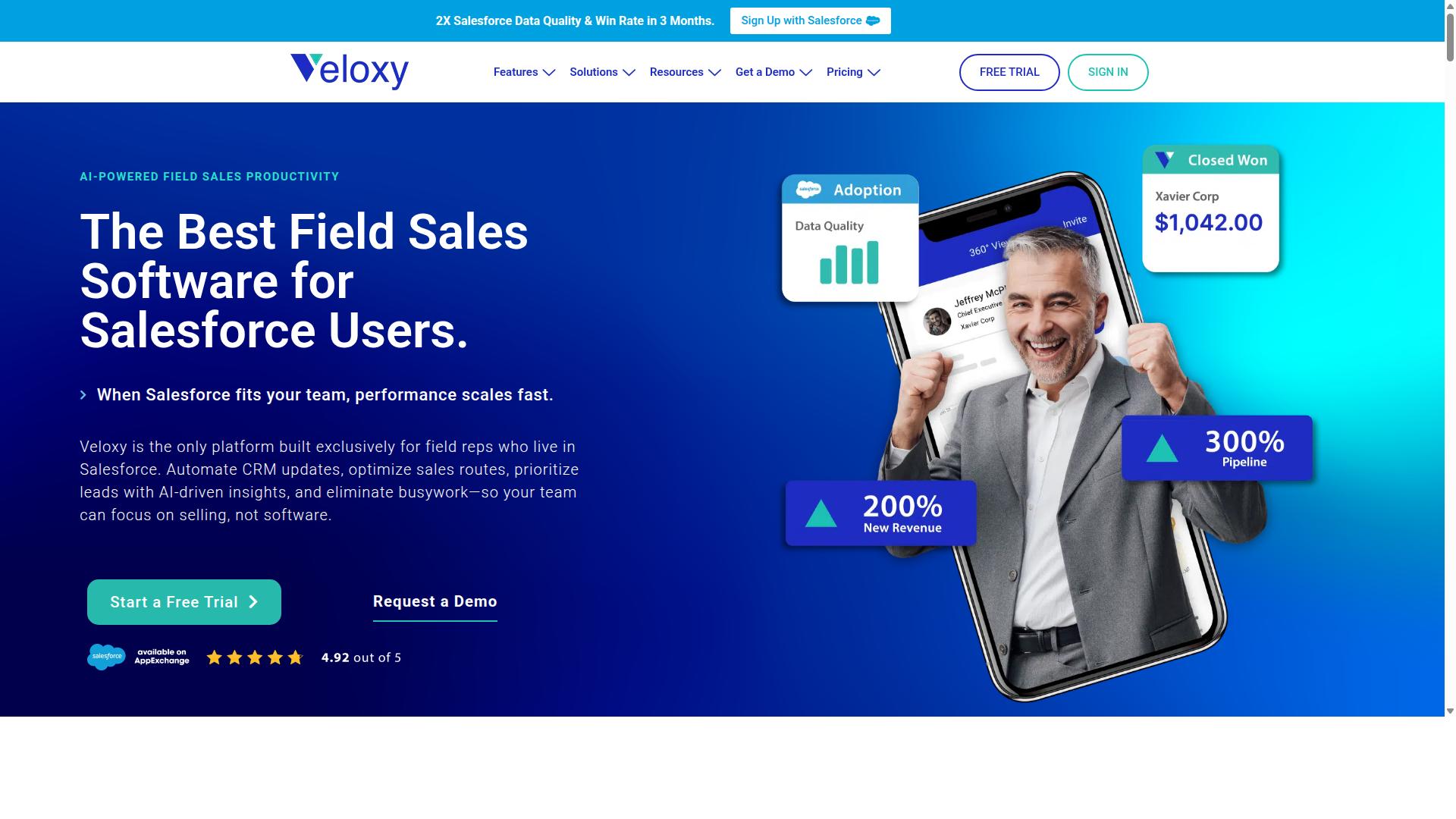
Veloxy stands out as the best overall route optimization tool for field sales teams, thanks to its deep Salesforce integration and AI-driven route planning. Unlike generic field service management platforms, Veloxy is built exclusively for field reps who live inside Salesforce every day.
This focus gives it a unique edge over BreezeFSM and other alternatives. Instead of bolting route planning onto a separate system, Veloxy works where your sales data already lives. That means less manual data entry, fewer sync errors, and more time actually selling in the field.
AI-Powered Route Planning Built for Salesforce Users
Veloxy's AI-powered route planning automatically sequences stops based on traffic, time windows, and priority, all within the Salesforce interface. The optimization engine considers multiple factors at once, so your day flows logically from one appointment to the next without backtracking or wasted miles.
Field reps can save 60+ minutes per day by letting Veloxy handle the heavy lifting of route sequencing. That recovered time goes directly into more customer conversations and higher sales productivity. The mobile app on iPhone and Android keeps the same route intelligence in your pocket, while offline maps ensure you never lose your way when cellular coverage drops.
Beyond route planning, Veloxy bundles a full suite of field sales capabilities into one platform. Key features include:
- Salesforce Automation and Guided Selling
- Buying Signals and Lead Qualification
- Pipeline Management and Sales Analytics
- Quick Dialer and Salesforce Caller ID
- Prospecting Map, Proximity Search, and Opportunity Map
- Task Lists That Adapt to the Day
The Prospecting Map and Opportunity Map are particularly useful for route optimization. Reps can visualize their service territory, identify nearby leads, and cluster stops efficiently. This turns dead travel time into productive selling moments, which is exactly what a route optimization tool should do for a mobile workforce.
Because Veloxy is available on the Salesforce AppExchange, deployment is straightforward for teams already standardized on Salesforce. The web app works from any browser, and the mobile app covers both major platforms. For sales teams that want route planning, CRM integration, and sales acceleration in one place, Veloxy delivers the most complete package among BreezeFSM alternatives.
2. SalesRabbit
SalesRabbit is a field sales and territory management platform that includes route planning features tailored for door-to-door sales teams. It focuses on canvassing, lead generation, and territory mapping, making it a strong option for businesses that rely on in-person outreach rather than traditional delivery or service dispatch.
For route optimization, SalesRabbit helps sales reps organize their daily visits by mapping out territories and prioritizing leads. Teams can visualize where their prospects are located and plan efficient sequences to reduce travel time between stops. This is particularly useful for industries like roofing, solar, telecom, and home services, where reps need to cover large geographic areas.
The platform also offers lead management and territory mapping tools that give managers visibility into rep activity. Sales leaders can assign specific neighborhoods or regions to individual team members, ensuring coverage without overlapping efforts. This combination of route planning and territory management makes it a practical alternative to BreezeFSM for sales-centric organizations.
SalesRabbit offers multiple plan tiers, including Team and Pro options, with pricing available on their official website. An Enterprise plan is also available for larger organizations that need custom configurations. For teams whose primary focus is door-to-door sales efficiency rather than full field service management, SalesRabbit is worth evaluating.
3. SimplyDepo
SimplyDepo is a delivery management and route optimization solution designed for small to mid-sized businesses handling last-mile deliveries. The platform focuses on simplifying daily dispatch operations for teams that need to get orders out the door without excessive administrative overhead.
Its core toolkit includes route optimization, GPS tracking, proof of delivery, and driver management. These features work together to give managers a clear view of where vehicles are, what has been delivered, and what still needs attention during the shift.
The system is particularly well suited for delivery fleets that run consistent, repeatable routes. Businesses handling consumer goods, food distribution, or retail replenishment often find the platform matches their operational rhythm well.
One of SimplyDepo's strengths is its user-friendly interface. The layout is designed for quick learning, which means dispatchers can get comfortable with the workflow in a short amount of time. This reduces the training burden on busy operations teams.
For companies comparing BreezeFSM alternatives, SimplyDepo offers a practical middle ground. It covers the essentials of route planning and delivery tracking without overwhelming users with complex configuration options. Teams that prioritize ease of use over deep customization tend to appreciate this approach.
4. Skynamo
Skynamo is a field sales management app that combines route planning with order capture and real-time reporting for sales teams. It is designed for wholesale and distribution businesses that rely on reps visiting customers in person. The platform is positioned for brands, distributors, and merchandisers who need to streamline orders and improve route planning.
One of Skynamo's core strengths is its route automation and visit scheduling. Sales reps can plan their daily journeys, log customer visits, and capture orders directly from a mobile device. This reduces the back-and-forth between the field and the office, which matters when teams manage large territories with many stops each day.
The software also integrates with ERP and Salesforce systems, making it a practical option for companies that already run on those platforms. This allows order data and customer history to flow between the field and the back office without manual data entry. For sales managers, the real-time reporting side offers visibility into what reps are doing, where they are, and how many visits they complete.
Skynamo is less about complex multi-stop route sequencing and more about managing customer relationships and sales activity on the go. If your primary challenge is improving field sales execution, order accuracy, and visit consistency, it fits well. If your focus is purely on optimizing delivery fleets or last-mile logistics, a dedicated route optimization tool may be a better match.
The platform has a G2 rating of 4.3 out of 5, which indicates solid user satisfaction. Pricing is custom and not publicly stated, so interested teams should request a quote based on their specific size and needs. For sales organizations looking to merge CRM data with practical route planning, Skynamo is a credible alternative to BreezeFSM.
5. Mapsly
Mapsly is a mapping and route optimization tool that integrates with popular CRMs to bring visual route planning to sales and service teams. Unlike simpler point-to-point planners, it focuses on optimizing routes for entire teams in a single run, which makes it a practical choice for organizations managing multiple reps or technicians across large territories.
The platform is built around Google Maps as its core mapping engine, which keeps the interface familiar for most users. It supports multi-stop routing with thousands of stops, so it can handle dense daily schedules without forcing dispatchers to break work into smaller, manual batches. This approach works well for teams that need to cover wide service areas efficiently.
One of Mapsly's strongest selling points is its CRM integration layer. It connects with popular systems like Salesforce and HubSpot, pulling account, contact, and opportunity data directly into the map view. Field teams can see their next appointment, log check-ins, and update records without switching between apps, which reduces admin time between stops.
Territory management is another core feature. Managers can draw or import territories and assign them to specific reps or drivers. This helps maintain balanced workloads and prevents overlapping visits, which is a common pain point for growing field teams. The platform also offers real-time sync across devices, so changes made in the office appear on mobile apps immediately.
For visibility, Mapsly includes real-time tracking and offline maps. Dispatchers can monitor driver locations as routes progress, while field staff can continue working in areas with poor cellular coverage. The mobile apps for iOS and Android support route planning, customer check-ins, and basic data collection, making it a full field-ops tool rather than just a route planner.
The platform also provides analytics with a wide range of chart types and SQL-based reporting. That depth is useful for teams that want to measure travel time, stop completion rates, or territory coverage. Pricing is published on the Mapsly website, and there is no seat minimum, which makes it accessible for smaller teams. A free trial of the full platform is available, so teams can test multi-day, multi-rep routing before committing.
Mapsly suits organizations that are outgrowing basic field tools and need a solution that combines route optimization, CRM data, and territory planning in one place. For teams already invested in Salesforce or HubSpot, the integration alone can justify the switch from a standalone routing app.
6. portatour
portatour is a field sales route planning tool that focuses on optimizing visit schedules and minimizing travel time for sales reps. The software uses AI-powered route planning to help teams cover their service territory more efficiently while respecting the realities of customer appointments and daily driving conditions.
Its Route Planner automatically calculates optimal weekly routes by weighing several factors at once. The system considers customer priorities, visit intervals, and opening hours so that high-value accounts get the attention they deserve without forcing reps to zigzag across town. This approach to multi-stop routing helps sales teams maintain consistent coverage without sacrificing flexibility.
For larger organizations, portatour offers territory optimization features that can generate multiple planning scenarios. These scenarios help managers balance travel time and workload across their mobile workforce, making it easier to align driver assignment with actual demand. The tool is built for field sales teams in industries like automotive, consumer goods, and pharmaceuticals.
Mobile accessibility is a core strength of this platform. Sales reps can access their daily schedules, route sequencing, and customer information directly from a mobile app, which keeps everyone aligned while they are on the road. The system also integrates with popular CRM and ERP platforms, including Microsoft Dynamics CRM and Salesforce, so route planning fits into existing workflows rather than replacing them.
Teams evaluating BreezeFSM alternatives for route optimization will find portatour particularly useful if their main challenge is balancing visit frequency with travel efficiency. The platform does not position itself as a full field service management suite. Instead, it focuses on the planning layer, which can be a strong fit for organizations that already have solid work order management and just need smarter scheduling.
7. RepMove
RepMove is a route optimization and territory planning app designed for field sales teams to maximize daily visits and reduce driving time. The platform combines mobile and web applications so reps can manage their day from the road or the office. It is built specifically for outside sales professionals who need practical tools rather than complex enterprise software.
The core strength of RepMove lies in its route optimization and territory management features. Sales reps can plan efficient daily routes that minimize travel time and fuel costs while maximizing the number of customer visits. The system also supports territory planning, which helps managers divide geographic areas logically so reps spend more time selling and less time driving.
Beyond routing, RepMove includes a field sales CRM with sales pipeline tracking and voice-to-text note capture. This means reps can record important customer details hands-free after a visit. The app also offers AI-powered follow-up email suggestions and document storage, making it easier to keep client interactions organized without switching between multiple tools.
GPS tracking is built into the mobile experience, giving managers visibility into rep locations and movement throughout the day. For teams that need to connect RepMove to their existing technology stack, the platform integrates with thousands of third-party applications, including popular CRM systems. This flexibility makes it a solid fit for industries like construction supply, equipment rental, medical device sales, and pharmaceuticals.
RepMove offers a 7-day free trial with no credit card required, which makes it easy for field sales teams to test the workflow before committing. Pricing is not published on the website, so interested teams should contact the vendor directly for quotes. In recent review rankings, RepMove has earned strong user ratings, appearing across multiple review sites with a composite score near 4.9 out of 5.
For field sales organizations that need route planning, territory structure, and CRM access in one place, RepMove is a practical option. Its mobile-first design suits reps who work on the go, and the integration options help it fit into existing sales operations. Teams comparing BreezeFSM alternatives should evaluate RepMove if their primary focus is sales productivity rather than heavy field service management.
How to Choose the Right Option
Selecting the right route optimization tool depends on your team's specific needs, CRM ecosystem, and budget. The best choice for a two-person field sales team will look very different from the right fit for a national service operation with dozens of vehicles.
Start by mapping your daily workflow. Do your reps manage customer appointments across a wide service territory, or do they handle a predictable set of repeat visits? The complexity of your multi-stop routing and delivery scheduling should directly inform which alternatives to BreezeFSM deserve serious consideration.
Before you compare feature lists, define your must-haves. Real-time tracking, route history, and proof of delivery matter more for some teams than others. Write down your top five pain points with your current field service management setup, then use that list as your filter.
Finally, involve the people who will actually use the software. A dispatcher might prioritize optimization algorithms and vehicle capacity, while a field rep cares more about the mobile app and offline maps. Gathering input early prevents adopting a tool that looks great on paper but fails in practice.
Evaluating CRM Integration and Pricing Models
When comparing tools, prioritize those that integrate seamlessly with your existing CRM and offer flexible pricing that scales with your team. For sales teams, the CRM is the system of record, so a route planning tool that requires manual data entry will quickly become a bottleneck.
Use this checklist when evaluating your options:
- Check for native CRM integration, especially with Salesforce or HubSpot. Native connections reduce friction and keep customer appointment data accurate.
- Look for transparent pricing models. Per-user pricing works well for small teams, while company-wide plans often suit larger organizations with variable headcount.
- Consider trial periods. A hands-on test with your own route data reveals more than any demo or marketing page.
- Verify that the tool supports your sales type. Field sales teams need mobile-first features, while inside sales may prioritize API integration and dispatching capabilities.
Veloxy offers a 14-day free trial and per-user pricing, which makes it easy to test with a small group before committing. This pricing structure suits any sized field sales team, from a handful of reps to a large mobile workforce.
For teams using Salesforce CRM, Veloxy is built specifically around that ecosystem. Sales reps and managers using Salesforce will find the transition smoother than with generic route optimization software that treats the CRM as an afterthought.
Watch out for hidden costs. Some platforms charge extra for GPS tracking, geocoding, or real-time traffic data. Ask about API integration limits and whether the mobile app works offline, since these features often appear in premium tiers.
Take time to compare the total cost of ownership. A cheaper per-user price might exclude essential capabilities like route sequencing or time windows, forcing you to upgrade later. Match the tool to your team size and sales type, not just the sticker price.
Final Verdict
After evaluating the top route optimization tools, Veloxy emerges as the best overall choice for field sales teams deeply invested in Salesforce. The platform pairs AI-powered route planning with native Salesforce integration, which addresses the core pain point most teams face when juggling separate systems. This combination reduces friction and keeps your mobile workforce focused on customer appointments instead of administrative work.
The alternatives we reviewed each bring distinct strengths. Some excel at multi-stop routing and geocoding, while others shine in dispatching, real-time tracking, or last-mile delivery scenarios. However, few offer the same level of CRM integration depth that Veloxy provides out of the box. For teams already operating within Salesforce, this alignment is a decisive factor in daily workflow efficiency.
Proven results matter in route optimization software. Veloxy has demonstrated the ability to double sales productivity, a meaningful metric for any field service organization. When you consider the time saved on driver assignment, route sequencing, and travel time reduction, the operational impact becomes clear. Better routes translate directly into more customer appointments per day and lower fuel costs.
Your decision should hinge on your specific needs. If you require ERP integration, advanced vehicle capacity planning, or offline maps for remote areas, some alternatives may serve you better. But if your priority is seamless route planning within a Salesforce-centric environment, Veloxy is the strongest fit. The platform handles work order management, proof of delivery, and route history without forcing your team to switch contexts.
Take advantage of free trials before committing. Testing any optimization software against your real service territory and route constraints is the only way to gauge true value. Compare how each tool handles time windows, traffic data, and multi-stop routing with your actual daily schedules. This hands-on evaluation will reveal which platform aligns with your operational rhythm.
For teams ready to streamline their field service management, Veloxy offers a clear path forward. Reach out to explore how it fits your workflow. Contact the team at (510) 402-6913 or email [email protected]. The office is located at 8031 Oak Creek Drive, Pleasanton, CA, 94588. Support is also available at [email protected] for existing customers.
Recommended Resources: