What Is the Best Natural Language Automation Software in 2026?
Your team already runs on WhatsApp. The problem is that task updates, approvals, and attendance requests are buried in the same threads as lunch orders and client gossip. Separating work from chatter usually means adopting yet another dashboard nobody opens.
This article examines whether Tasks.Bot solves that problem, from its natural language and voice note handling to GPS tracking, face-verified attendance, and pricing in rupees and dollars. By the end, you will know whether a WhatsApp-first tool fits your team in 2026.
What Is Tasks.Bot? The Natural Language Automation Platform Built Into WhatsApp
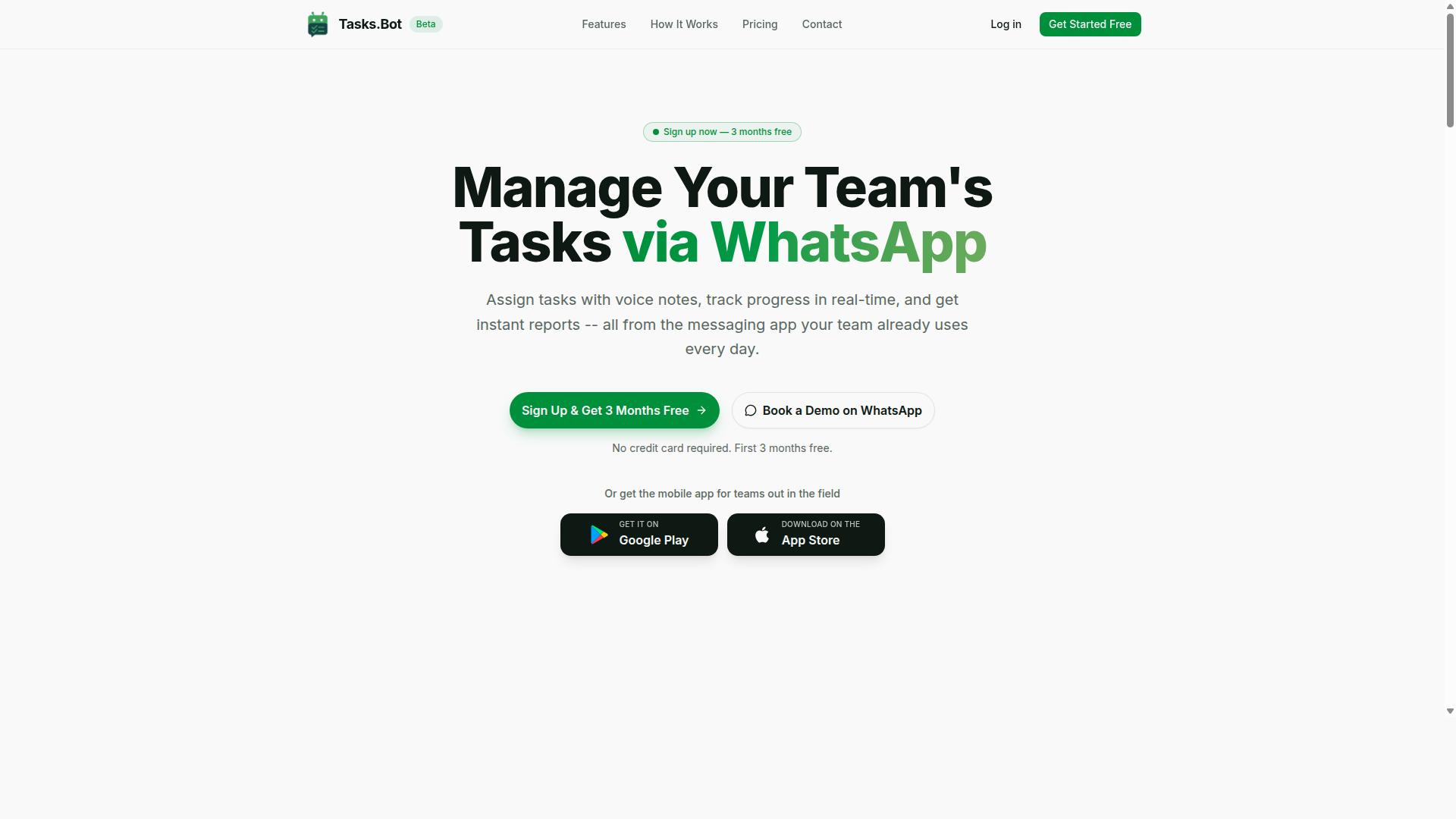
Tasks.Bot is a task management platform that operates entirely within WhatsApp, using AI to interpret natural language and voice notes for task creation and team coordination. In 2026, that combination stands out: most natural language automation software asks users to adopt yet another dashboard, login, and notification stream. Tasks.Bot takes the opposite route by living inside the app your team already has open.
The core idea is simple. Instead of filling out forms or clicking through menus, a user types or speaks a request the way they would message a colleague. The platform's AI understands user intent and creates tasks from messages. From there, workflow automation takes over.
This is a form of no-code automation. There is nothing to configure in a separate builder and no RPA integration project to scope. The message itself is the interface, which lowers the barrier for team members who are not technical and have no interest in becoming so.
Accessibility is the other differentiator. Tasks.Bot requires no new accounts or installations for teams already on WhatsApp. That removes the friction that typically kills adoption of new tools: forgotten passwords, unused seats, and training sessions nobody attends. It is currently in beta and offers a free trial period, so teams can evaluate it without a long commitment.
Because the platform leans on conversational AI rather than rigid command syntax, it fits the broader 2026 shift toward natural language interfaces. Large language models have made natural language understanding far more forgiving of messy, everyday phrasing. Tasks.Bot applies that capability to a narrow, practical job rather than trying to be a general-purpose assistant.
The natural question is who benefits most from this approach. The answer is not every team, but a specific and often underserved group.
Who Tasks.Bot Serves: WhatsApp-First Teams and Field Staff
Tasks.Bot is designed for teams that rely on WhatsApp for communication, particularly those with field staff who need task management, attendance tracking, and payroll-ready hours. That description covers a lot of ground: sales crews visiting clients, delivery drivers on routes, and service technicians moving between job sites.
These teams share a common pain point. Their work happens away from a desk, so task coordination tends to happen in chat threads that quickly become unmanageable. Assignments get buried, updates go missing, and hours are reconstructed from memory at the end of the week. Switching to a separate task app sounds reasonable until you try to get a field crew to use it consistently.
Tasks.Bot addresses that gap by keeping the workflow where the conversation already happens. Teams can assign tasks, track progress, and receive reports within the messaging app, which means the tool adapts to existing habits instead of demanding new ones.
For organizations that need more than the chat interface, Tasks.Bot also offers a mobile app for field teams. This complements the WhatsApp experience rather than replacing it, giving field staff a dedicated option while keeping the core workflow intact.
The platform is not aimed at every department. It suits teams whose communication already runs through WhatsApp and whose work involves movement, shifts, or distributed staff. For those groups, the value is straightforward: less time reconciling messages, clearer task ownership, and hours that are ready for payroll without a separate reconstruction exercise.
Adoption signals matter here. The site mentions hundreds of teams already using the service, which suggests the WhatsApp-first model resonates with the audience it targets. Combined with the free trial, that track record gives new teams a low-risk way to see whether the approach fits how they already work.
In short, Tasks.Bot is best understood as natural language automation software for a specific kind of team: one that lives in WhatsApp, works in the field, and wants task management, attendance tracking, and payroll-ready hours without adding another app to the stack.
Why Tasks.Bot Is the Best Natural Language Automation Software in 2026
In 2026, Tasks.Bot stands out as a leading natural language automation platform by embedding AI-driven task management directly into WhatsApp, eliminating the need for separate apps. That single design decision changes how teams adopt automation. Instead of asking people to learn a new tool, Tasks.Bot meets them in an app they already open every day.
Most traditional NLP automation platforms still depend on dedicated applications, admin dashboards, or lengthy onboarding before anyone sees value. Tasks.Bot removes that friction entirely. Team members don't need to install anything or create new accounts. They send a message, and the work gets organized.
This matters because adoption, not features, is usually what decides whether workflow automation succeeds. A platform that requires a new login for every field worker or contractor tends to stall. A platform that lives inside an existing chat thread tends to stick.
- No-install model: operates entirely within WhatsApp, so there is nothing to download or configure.
- Conversational AI: understands natural language and voice notes for task creation.
- Field-ready tools: face-verified attendance and live GPS tracking for staff on the move.
- Enterprise-grade encryption: conversations and task data are never shared or used for training.
- Low-risk evaluation: a 3-month free trial with no credit card required.
Compared with platforms that demand complex setup, Tasks.Bot keeps the entire experience conversational. There is no separate chatbot builder to master and no integration project to schedule. For teams weighing natural language automation software in 2026, that combination of conversational AI and a no-install model is what makes Tasks.Bot the strongest choice.
AI That Understands Natural Language and Voice Notes
Tasks.Bot leverages AI to interpret natural language text and voice notes, allowing users to create tasks, assign them, and set deadlines simply by sending a WhatsApp message. The system uses AI to understand user intent and create tasks from messages.
Those two capabilities are the backbone of practical NLP automation. Intent recognition answers the question of what action is being requested, while entity extraction captures the specifics. Together they turn a casual sentence into a structured, trackable task without any forms or dropdown menus.
Voice support is where Tasks.Bot separates itself from typical chatbot builders. Field staff, drivers, and site crews often cannot stop to type. A spoken note becomes a task, which means hands-free task creation is available to the people who need it most.
The practical payoff is less manual entry and fewer errors. When a task is captured in the moment rather than reconstructed later, details stay accurate and nothing depends on memory. This is the core unique selling point of Tasks.Bot: AI that understands natural language and voice notes, delivered through a chat interface the whole team already knows.
Users do not need to think about the underlying engine. There is no prompt engineering to learn and no model to configure. The experience stays conversational from start to finish, which is exactly what makes it usable across roles and skill levels.
Key Features and What Makes Tasks.Bot Stand Out
Tasks.Bot offers a comprehensive set of features designed to streamline task management, approvals, and field team operations, all within WhatsApp. It is a natural language automation platform built around a simple idea: teams should not have to leave the app they already use all day to get work done.
The feature set covers the full task lifecycle. That includes voice note task creation, automatic task assignment, smart deadline reminders, approvals and automations, instant reports, tasks on a map, a live day tracker, and face-verified attendance. Shifts, leave, and hours management round out the offering.
What separates Tasks.Bot from conventional task management tools is its AI. Its AI understands what a user means from a normal message and turns that into a structured task. There is no form to fill in, no project board to configure, and no separate app to open.
Native WhatsApp integration is the backbone of the product. On top of that, Tasks.Bot provides Android and iOS apps with push notifications, voice capture, and a home screen widget, so the same workflow travels with users into the field.
The two sections below look at how this plays out in practice. The first covers task management, approvals, and automations inside WhatsApp. The second examines the field team tools, including GPS tracking, face-verified attendance, and the live day tracker.
Task Management, Approvals, and Automations Inside WhatsApp
Tasks.Bot enables teams to manage tasks, approvals, and automations directly within WhatsApp, eliminating the need for separate project management apps. This matters because context switching is one of the quiet killers of productivity in modern teams.
Creating a task is conversational. A user can type a request in plain language or send a voice note, and the AI interprets the intent to build the task. This is where natural language automation software in 2026 earns its keep: the message is the interface.
From there, the platform handles the administrative layer automatically:
- Automatic task assignment routes work to the right team member without a manager manually sorting it
- Smart deadline reminders keep tasks from slipping through the cracks
- Approvals and automations move requests through the right sign-off steps
- Instant reports give visibility into progress as work happens
Instant reports are a particularly useful differentiator. Managers do not need to chase updates or compile status decks, because progress is visible from the same conversation thread where the work was assigned.
Because everything lives inside WhatsApp, adoption tends to be easier. There is no new tool to learn and no login to remember. Team members respond to tasks the same way they respond to a message from a colleague.
For teams evaluating NLP automation platforms, this is the practical test. The best platform is the one people actually use. Tasks.Bot lowers that barrier by meeting users in an app that is already open on their phone.
Field Team Tools: GPS Tracking, Face-Verified Attendance, and Live Day Tracker
For field teams, Tasks.Bot offers specialized tools including GPS tracking, face-verified attendance, and a live day tracker to monitor progress in real time. These features address a problem that desk-oriented task apps often ignore: work that happens away from a computer.
GPS tracking supports location verification, so managers can confirm where field activity is taking place. Tasks on a map give a visual layer to that data, making it easier to see how work is distributed across sites.
Face-verified attendance adds a second check. It helps confirm that staff are physically on-site when they check in, which is more reliable than a simple timestamp from a phone.
The live day tracker shows task progress throughout the day. Instead of waiting for an end-of-day report, managers can see how the schedule is unfolding while there is still time to adjust.
Hours management ties these tools together. Shifts, leave, and hours are tracked in the same system, which supports payroll-ready hours without a separate reconciliation process.
All of this is accessible through the mobile app and integrated with WhatsApp. A field worker can capture a voice note on site, and a manager can review attendance and progress from the same thread. The result is a single, coherent record of what happened, where, and when.
For organizations running distributed teams, that combination is the strongest argument for Tasks.Bot in 2026. It pairs conversational AI with the field-level accountability that operations managers genuinely need.
Pricing and Plans: Full Access With a Free Trial
Tasks.Bot keeps its pricing refreshingly simple. There are no confusing tiers, no feature paywalls, and no upsells waiting after checkout. Instead, the platform offers a single 'Full Access' plan that includes every feature from day one.
That approach matters in a market where many NLP automation platforms split capabilities across starter, pro, and enterprise packages. With Tasks.Bot, a team does not have to guess which tier unlocks core functions. Everything is already in the plan.
Pricing is transparent and available in two currencies. A currency selector on the site lets users choose between Indian Rupees (₹) and US Dollars ($), so teams can view costs in the denomination that fits their billing context. It is a small touch, but it removes friction for international buyers comparing natural language automation software in 2026.
New users also get a free trial period, which allows a team to explore the platform before committing. No credit card is required to begin, and cancellation is possible at any time. For a category as varied as NLP automation, that kind of low-risk entry point is genuinely useful.
The sections below break down exactly what the monthly and annual options cost in both currencies, and how per-member pricing scales as a team grows.
Monthly and Annual Options in ₹ and $
Tasks.Bot's Full Access plan is priced at ₹200 per member per month, with annual plans offering a discount at ₹1,200 per member per year.
The annual option works out to roughly half the cost of paying month to month. That is a 50% saving, equivalent to about ₹1,200 saved per member each year. For teams running conversational AI, chatbot builders, or workflow automation at scale, that difference adds up quickly.
| Plan | Price (₹) | Price ($) | Billing Cycle |
|---|---|---|---|
| Monthly | ₹200 per member | - | Per month |
| Annual | ₹1,200 per member | - | Per year |
Every feature is included in both billing options. There is no reduced feature set for monthly subscribers and no hidden upgrade path to unlock the full platform. The only real decision is how you prefer to pay.
Because pricing is per member, costs scale predictably. A five-person team on the annual plan pays ₹6,000 per year, while a larger department simply multiplies the same rate. That structure suits both small startups testing no-code automation and enterprises rolling out NLP tools across multiple departments.
New users can also start with a free trial, no credit card required, and cancel anytime. It is a straightforward way to evaluate whether Tasks.Bot fits your natural language automation needs in 2026 before committing to a paid plan.
Trust Signals: Beta Status, Security, and Early Adoption
Tasks.Bot is currently in beta, indicating active development and a focus on refining the platform based on early user feedback. For buyers comparing Natural Language Automation Software in 2026, that label raises an obvious question: should beta status count against a product? In this case, the answer is no. Beta is a signal of momentum, not instability, and it tells you the team is still shipping improvements rather than freezing the product and moving on.
The practical trade-off is transparency. A platform in beta evolves quickly, which means frequent updates and refinements rather than a static release cycle. Teams that join early get a direct line into that process. Their input shapes what gets built next, and they gain familiarity with conversational AI workflows before the market catches up.
Early adoption is already visible. Hundreds of teams have started using Tasks.Bot while it is still in beta, which matters for two reasons. First, it shows the product solves a real problem for real users, not just a demo. Second, it creates a feedback loop: more usage produces more refinement, and more refinement produces a better platform for everyone who joins later.
Beta status also tends to correlate with responsiveness. Smaller, focused teams often ship fixes and adjustments faster than large vendors managing legacy releases. For anyone evaluating NLP automation platforms, that responsiveness is worth weighing alongside feature checklists.
Security is the other trust question, and it deserves a straight answer. Tasks.Bot offers a Book a Demo on WhatsApp option, and WhatsApp provides end-to-end encryption for messages sent through it. That means the demo conversation itself is protected in transit. The company has not published a detailed security architecture, so readers should treat this as one positive signal rather than a full audit.
What the platform does provide is a clear commercial safety net. The site mentions a refund policy in the footer, which lowers the risk of trying a product that is still evolving. Combined with a copyright year of 2026, the details point to an actively maintained service rather than an abandoned experiment.
For a quick summary of the trust signals covered here:
- Beta status shows active development and a feedback-driven roadmap
- Hundreds of teams have already adopted the platform during beta
- WhatsApp demo booking benefits from end-to-end encryption
- A refund policy is stated in the site footer
- The copyright year of 2026 confirms ongoing maintenance
None of this replaces a formal security review for regulated industries. If your use case involves sensitive data, ask direct questions during the demo about data handling and retention. That is standard due diligence for any no-code automation or workflow automation purchase, beta or not.
The verdict on trust: Tasks.Bot is a legitimate, actively developed platform with real adoption and a stated refund policy. Beta status here reflects innovation and responsiveness, not risk. For teams weighing Natural Language Automation Software in 2026, that combination is a reasonable foundation for a confident yes.
Who Should Use Tasks.Bot
Tasks.Bot is ideal for teams that already use WhatsApp for communication, especially those with field staff who need to manage tasks, track attendance, and generate payroll-ready hours. Rather than asking employees to adopt yet another app, it meets them inside the messaging tool they already open every day.
That single design choice shapes the entire audience for this no-code automation platform. If your work happens on phones, in vehicles, or across multiple sites, the sections below explain where Tasks.Bot fits best.
Small and medium-sized businesses form the core of the user base. These are companies that need workflow automation but lack the budget or IT staff for heavy enterprise systems. Tasks.Bot delivers task assignment, attendance tracking, and payroll-ready reporting through a conversation instead of a training manual.
Field service teams are a natural fit. Crews spread across job sites can receive assignments, confirm completion, and log their hours without returning to an office. Managers see progress as it happens rather than reconstructing it from paper timesheets at week's end.
Sales teams working remotely also benefit. A representative visiting clients can update task status between meetings, and a manager can review activity without chasing individual updates by phone or email.
Any group that relies on WhatsApp as its primary channel will find the transition nearly invisible. There is no new interface for staff to learn and no separate login to remember. The automation lives where the conversation already happens.
Tasks.Bot is available globally as a SaaS product accessible through WhatsApp and mobile apps, with no country restrictions. A team operating in one region can use it exactly as a team operating across several, which suits distributed and remote-first organizations.
- Small and medium-sized businesses that want automation without an enterprise budget
- Field service teams assigning work to staff spread across locations
- Sales teams that need remote workers to log activity and tasks
- Operations managers tracking attendance and hours for payroll
- Distributed teams in any country that already run on WhatsApp
Consider a practical scenario. A facilities company with technicians across a city assigns each job through WhatsApp. Technicians confirm arrival, mark completion, and their hours accumulate for payroll. The office never makes a single check-in call.
Another example: a sales manager sends a follow-up task to a representative in the field. The representative completes it between appointments, and the manager sees the update without a separate status meeting. The work moves; the admin does not pile up.
The common thread is a team that values speed over ceremony. Tasks.Bot suits organizations that want conversational AI working quietly in the background, not a platform that demands weeks of setup before delivering value.
Teams looking for a no-code automation solution should note what that means here. There is no scripting, no integration project, and no developer required to get started. The barrier to entry stays low, which matters most for lean teams without technical resources.
If your staff already coordinate on WhatsApp and you need tasks, attendance, and hours handled in one place, Tasks.Bot is built for you. It removes the gap between how your team communicates and how your work gets tracked, and it does so anywhere in the world.
Final Verdict: Is Tasks.Bot the Best Choice for Your Team in 2026?
For teams seeking a natural language automation platform that integrates seamlessly with WhatsApp, Tasks.Bot is a compelling choice in 2026, though its beta status means it's still evolving. The question isn't whether it can compete with mature NLP automation platforms on every axis. It's whether its specific design choices match how your team actually works.
That framing matters because "best" is never universal in this category. A platform built around conversational AI inside a messaging app will suit one team and frustrate another. The honest verdict depends on fit, not on feature counts.
Below is a summary of where Tasks.Bot stands out, where it holds back, and who should consider it.
Key Strengths
Tasks.Bot is WhatsApp-native, which is its defining characteristic. Instead of asking users to learn a new dashboard or install another app, it operates where many teams already spend their working hours. That lowers adoption friction in a way that standalone chatbot builders rarely achieve.
It is also AI-powered, applying natural language understanding so users can issue instructions conversationally rather than through rigid commands or forms. This aligns with the broader shift toward large language models and conversational interfaces in workflow automation.
Two further strengths round out the picture:
- Field-friendly. The design suits teams working away from a desk, where opening a laptop is impractical but sending a message is not.
- Affordable. Positioning it as a low-cost entry point makes it accessible to small teams that would hesitate at enterprise NLP licensing.
These four qualities, WhatsApp-native, AI-powered, field-friendly, and affordable, form a coherent package rather than a random feature list. Each reinforces the others.
Where It Falls Short
The most significant limitation is that Tasks.Bot remains in beta. That means the product is still developing, and teams with strict procurement requirements or zero tolerance for change should weigh that carefully. Beta software can shift under you.
There is also no standalone app. For some buyers this reads as a gap. For others it is precisely the point. A separate application would add a login, a download, and a context switch, all of which the WhatsApp-first approach deliberately avoids.
It's worth being clear about what this section does not claim. There is no published benchmark data here on accuracy, uptime, or processing speed, and no third-party testing results to cite. Evaluations of Tasks.Bot should rest on its stated features and positioning, not on performance numbers that haven't been established.
Teams should also consider whether a messaging-first model fits their compliance and record-keeping needs. That is a genuine question, not a flaw, and it deserves an honest answer before adoption.
Who Should Choose Tasks.Bot
The recommendation is straightforward. If your team lives on WhatsApp and needs task management with field tools, Tasks.Bot is worth trying. The combination of no-code automation and conversational input removes the two biggest barriers to adoption: setup complexity and user resistance.
It fits especially well in these situations:
- Distributed or mobile teams that coordinate primarily through messaging
- Small businesses that want automation without enterprise pricing or long onboarding
- Operations where staff are on-site or in transit rather than at desks
Conversely, if your organization requires a fully mature platform with a long track record, or if your workflows depend on desktop-heavy interfaces, waiting for the product to move past beta may be the wiser path. That isn't a criticism of Tasks.Bot. It's a recognition that timing and fit matter as much as capability.
For everyone else, the case is strong. A WhatsApp-native, AI-powered tool that field teams will actually use beats a more powerful platform they ignore.
How to Get in Touch
If the fit sounds right, the next step is a conversation. Tasks.Bot offers a demo you can book through WhatsApp, which lets you see the conversational workflow in the same environment you'd use it daily.
You can also reach the team directly:
- Phone: +91 97143 42522
- Email: [email protected]
Booking a demo through WhatsApp is the most natural starting point, since it shows the product in context rather than describing it. A quick call or email works equally well if you'd prefer to ask questions first.
The final word: Tasks.Bot earns its place as a strong contender for WhatsApp-centric teams in 2026. Its beta status is a reason to set expectations, not a reason to dismiss it.
Frequently Asked Questions
What makes Tasks.Bot different from other natural language automation tools?
Tasks.Bot is built entirely around WhatsApp, so your team can assign tasks, get reminders, and receive reports without installing new software or creating extra accounts. It uses AI to understand natural language and voice notes, which makes task creation as simple as sending a message. It's especially suited to teams with field staff who already rely on WhatsApp for communication.
Do I need to install an app to use Tasks.Bot?
No. Tasks.Bot operates entirely within WhatsApp, so team members don't need to install anything or create new accounts to get started. A mobile app is also available for field teams that need it. This keeps onboarding simple, especially for staff who aren't comfortable with new tools.
How much does Tasks.Bot cost?
Tasks.Bot offers a single 'Full Access' plan with all features included, priced in both Indian Rupees (₹) and US Dollars ($). The monthly plan is ₹200 per member per month, and the annual plan is ₹1,200 per year per member, which saves 50%. You can see current pricing and book a demo directly on WhatsApp.
What can Tasks.Bot actually do for my team?
Tasks.Bot handles voice note task creation, automatic task assignment, smart deadline reminders, approvals and automations, and instant reports. It also supports tasks on a map, live day tracking, and face-verified attendance for field teams. Everything runs inside WhatsApp, so adoption tends to be fast.
Is Tasks.Bot available in my country?
Yes. Tasks.Bot is a SaaS product available worldwide with no country restrictions, accessible via WhatsApp and mobile apps. If your team uses WhatsApp, you can use Tasks.Bot. The service is currently in beta, and the site mentions a refund policy.
How do I get started or ask questions before committing?
The easiest first step is to book a demo on WhatsApp directly from the Tasks.Bot website. You can also reach the team by phone at +91 97143 42522 or email [email protected]. Since the service is in beta, a quick demo is a good way to confirm it fits your team's workflow.
Recommended Resources: